

Swing Gate Operators
There are five types listed below:
Swing Gate Operators with Arm On Top. These are the most common units and are the work horses of the industry. A high end unit can last up to 20 years. Most of these units have heavy gear reduction oil bath gear boxes. They are generally very heavy in weight, many weigh up to 100 Lbs. and are large in size. A couple of drawback to them is the arm has to be removed to remove the cover for service. Some of them have an access panel to service the controls, but you still need to remove the cover to service the mechanics. The other drawback is the arm generally ends up in the middle of your gate where it can be unsightly.
Swing Gate Operators with Bottom Arm. DoorKing is the only operator that has the arm on the bottom. In general, they are not built as heavy as the top arm units, but do last as long. The two benefits of this type of unit is that the cover pops right off to reveal the entire unit and is one of the easiest units to service on the market. The other benefit is the arm on the bottom makes a very clean install, and won't detract from your gate esthetics.
Linear or Ram Arms. These units are being used more frequently and offer an ease of installation since they do not need a concrete pad or footing. The actuators are small and mount directly to the gate. The electronics are housed in a separate control box which is typically mounted nearby. There are two types of Linear Arm Operators; Jack Screw and Hydraulic.
Jack Screw Linear Arm: The jack screw type is more common. Older models tend to jerk the gate when starting or stopping however, this has been refined with “soft start / stop” feature available on most models. One drawback to a Jack Screw Arm, is they have a little slack and the gate can wiggle a little. It is correctable with a positive stop in single gates, but much harder to correct in bi-parting gates.
Hydraulic Linear Arm: These units use a built in pump and hydraulic fluid to operate and usually cost more. The benefit to hydraulic units, is there is no play in either the closed or open positions and gate operation is silky smooth. The drawback is they can leak hydraulic fluid as they get older. All of these units require positive stops on the gate.
Underground or In-Ground Operators: These are the Rolls Royce of operators and are almost completely invisible. They are a little costlier to install and service, just like any fine automobile. Underground Operators are available in two types; Mechanical and Hydraulic.
Mechanical Underground Operator: These are mostly run on 24 Volts DC these days with a separate control panel. Very dependable, but a little harder to adjust for height differences on bi-parting gates. They have built in motors and limit switches on most models so positive stops are not necessary, but still recommended.
Hydraulic Underground Operator: Still the choice for the most outstanding installations. They are silky smooth and the operating pressure is fully adjustable. They require positive stops. They come with built in pumps and external pumps. The control cabinet is separate. On very classy installations the control cabinet can be flush mounted into a column.
Cantilever Operator: This operator lifts the gate into the air from one end on a fulcrum. It is a specialty item and is useful in some space restricted installations or areas of heavy snow.
Access Control & Entry Systems
There are many ways to open your gate and secure your property. Here are the most common methods.
Radio Remotes: Almost all gate systems have a radio remote, comprised of a receiver and transmitter(s), they are similar to the ones used on your garage door. Some of them are a little more sophisticated in that they are numbered and the gate system can track them. Most of remotes are good for up to 100 Ft. and the range can be extended by adding an external antenna. Some units are rated for very long distance, but be wary as many do not live up to the range they specify.
Digital Keypads are usually stand-alone, but many units can have slave keypads attached to them for controlling additional entry points. Digital Keypads control the gate by entering an access code or PIN which are programmed by the user. Most models can open the gate momentary or lock it open. Keypads do not normally have a way of communicating with residence however, a pushbutton signal can generally be added.
Telephone Access Systems have built in keypads and communicate from the gate to the residence through the existing phone system locally or the phone network.
Residential telephone access systems typically use the existing phones in your home, and are directly connected to them. They also have the capability to use your phone line to make outside calls. This is very convenient when you’re not at home. The gate can be opened remotely through any phone including mobile phones.
These are very sophisticated devices which can perform many functions; a few common features are:
- Controlled by any phone in your house that is on the line connected to the unit
- Open and close the gate by time of day and day of week
- Codes which are restricted to time and dates; perfect for scheduled household services such as landscape maintenance, housekeepers, pool cleaners, etc.
- Codes that expire after a certain date; useful for events
- Optional built in CCTV cameras
Card Readers: These are more popular in commercial installations and community gates. The cards are exclusively numbered. If a card is lost it can be removed from the system and many of these systems can track the card user’s activities. There are close proximity readers that need to be with a few inched to operate. There are long distance readers that can read a card up to 10' away much like the fast track cards for bridge tolls
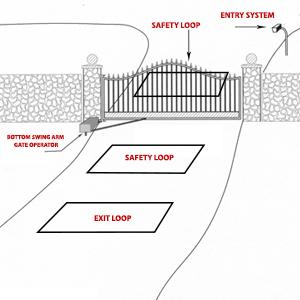
Loops: Are buried beneath your driveway during construction or cut in for existing driveways. They act much like a metal detector and open the gate when you drive over them, or act as a safety preventing the gate from closing on your vehicle. These type of loops have a separate circuit usually located in the gate control cabinet.
Exit Loop: Used to open the gate upon exit. You can have more than one exit loop. They should be installed as far back from the gate as possible but do not exceed 400 Ft. It is nice to drive through a gate that is already open, if you have the luxury of a long driveway.
Safety and Reversing Loops: These loops are in front of and behind the gate to prevent the gate colliding with a vehicle.
Shadow Loop: Used to prevent a vehicle from following another vehicle in. They are not used very often, and mostly on community and commercial gates.
Probe Style Detectors: These are self-contained and used primarily as an exit device. They are also used as an annunciator for approaching vehicles.